Keeping Emergency Supplies Current Without Replacing Everything Every Year
An emergency household setup typically doesn't fail completely. More often a single battery leaks, a food packet has gone past its best-before date, or nobody can find the pouch with the water treatment instructions. In such case when finally needed for a short power cut, Mara wouldn't throw away everything again but instead sort out the lot by condition, by use and by urgency. She goes into maintenance mode and ensures that she always has the right stuff to hand, without having to throw a lot of money at it every year.
Start with the situation, not the storage box
Mara's useful question for each of the scenarios above is: "What will make this emergency kit necessary?" Her answers will list a number of different supplies, all of which are needed for her different scenarios above.
Many items need to be with their owner at different times. In general, it's better to have several small items of the same type rather than one large container full of stuff. A headlamp is best used up during a blackout. A small compass and map for the daypack, and a copy of contact information for the car, for example. Sugar and other food items need to be with their owner at night, in their home.
Mara first considers what will be needed in each of the situations she has described for the need for a household emergency setup. These are: a temporary loss of power; a sudden need to leave a house; a sudden need to be out of doors; and a need to travel to a trailhead after normal services have ceased. Each of these situations will require a number of similar supplies, but some of these with different emphasis. The supplies could therefore be grouped into three categories: those used at home; those carried with her on outdoor activities; and those that would be needed for an evacuation and for traveling afterwards.
Give every item a condition, not just a place
A location is assigned to items that are already owned by the household. A condition check is needed to establish whether an item is still functional.
Mara will look for signs of possible damage, depletion, contamination and uncertainty. Torn or damaged packaging, cracked or corroded containers, strange smells, bloated batteries, missing parts or simply unreadable labels all need to be addressed. Even if an item is sealed it can deteriorate in heated, damp or sunny conditions. Specific items may have special storage requirements and need to be checked and/or replaced in accordance with the manufacturer's guidelines.
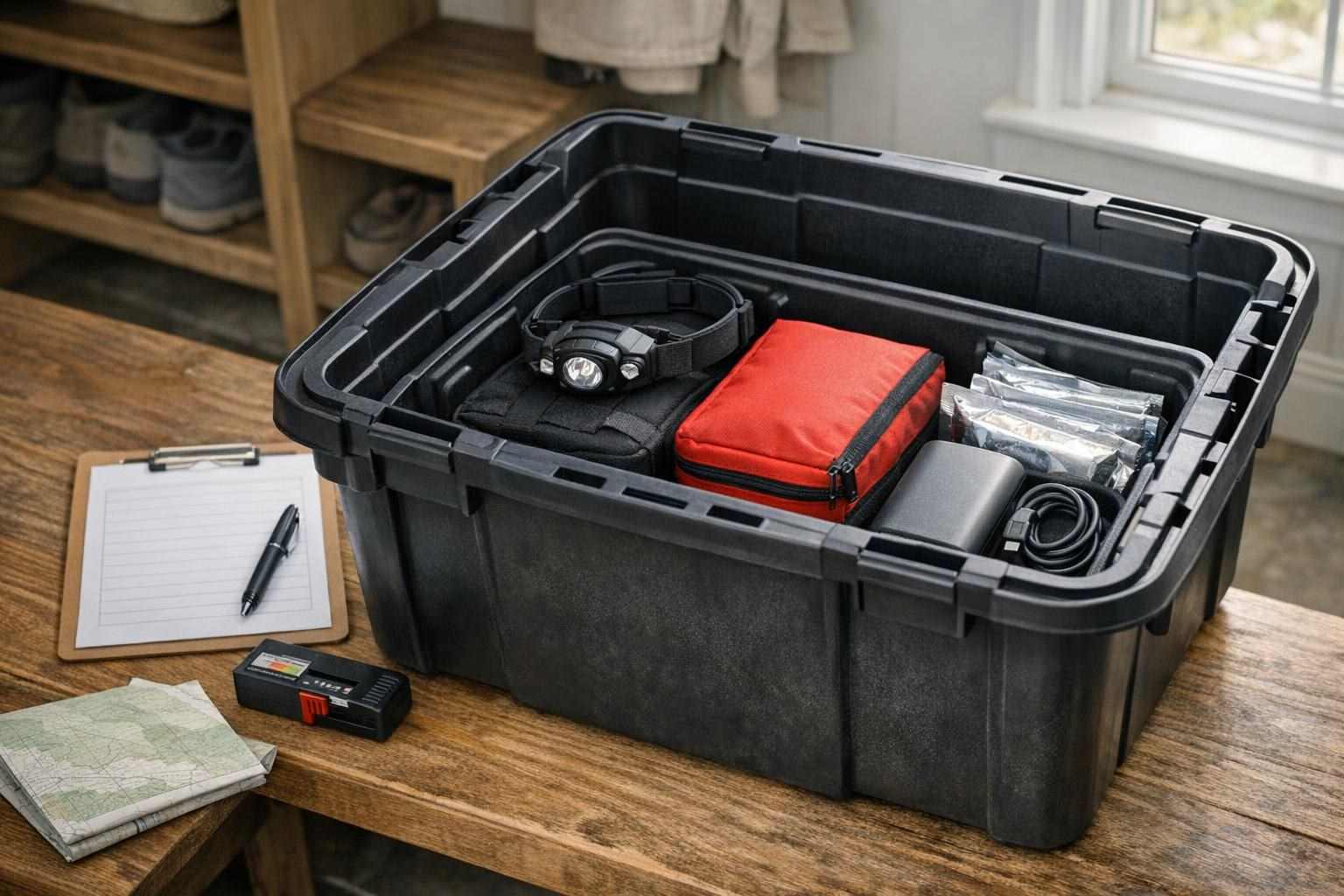
For some of your emergency supplies, you may need to check if they are working before using them in an emergency. Test your lights, check that you have the correct cables for charging and that all plugs are connected to the correct device. Check that your emergency shelter is still in good condition after being folded up and unfold it to test it. Make sure that you can use your compass, map and any other signaling devices that you have and that others in your household can use them too. Test these items in a controlled manner and then put them back in your emergency supplies.
Different items sustain different degrees of cosmetic damage before they cease to function. Thus a scuffed metal cup might be perfectly serviceable whilst a cable with exposed wires would be improper to retain even if it continues to function from time to time.
Treat expiration dates as decision points
Finally, date must be considered in terms of expiration date (Requirements), recommended change date (Guidance), shelf life (Product Nature), and finally condition of item (Observation). The inventory must reference current Requirements and Guidance.
Use a simple inventory sheet and write the relevant dates on it instead of trying to remember them all. Note down whether an item has to be replaced before a certain date, if it is to be used within a short time frame, or if it has no date of expiry at all but will have to be checked from time to time.
By stocking your emergency supplies with the same types of food that you normally use in your household you can ensure that items will get used up before they reach the end of their life and also help to make sure that you are not storing any unknown items. A good rule of thumb is that if you don't know what it is then don't buy it for your emergency supplies.
For specific medicines you have in your preparedness kit such as prescription, date-embossed and package-labeled products, ask the pharmacist where he or she would go for answers to your supply questions. A great place for that kind of guidance is a pharmacy.
Rotate supplies through normal life
Typically the most cost-effective method of maintenance is a loop of use. Mara keeps the newest items at the back of the shelves and notes what has been opened and is in the reserve in the normal household shopping. Batteries are charged for the trip and then returned to the storage area full. Plaster etc. are taken from the first-aid pouches and then replenished before the pouches are returned to storage.
The act of using and replacing items will also highlight potential flaws in your choice of quantity and of type. Are the water containers you have chosen to store for use in an emergency easily carried? Are there enough flashlights for all family members to be lit in the event of a power cut at night? Is the emergency evacuation kit that you have bought too heavy to carry in an emergency?
Don't consume dangerous or expired items but use sound items before they are put to the back of the store and eventually are forgotten. Follow the disposal instructions for old batteries, medicines, chemicals, and pressurized containers to get rid of them safely.
Build a checklist that reflects real use
Mara uses a check list to remember all the things she needs to take with her. It's only one page and includes location of the item, the item itself, condition of the item, action to take with the item and any relevant dates. The list is organized into three sections of household items that she would normally use, outdoor items that she would take on a trip and documents such as maps, a list of contacts and her route.
The most useful checks are specific:
– Can the intended user find and operate it without coaching?
– Is it complete, clean, and protected from moisture?
– Has anything been borrowed, opened, or moved?
– Does the stored power source still suit the device?
– Would the kit remain useful if leaving home became necessary?
– Are maps, contact details, and instructions still accurate?
Mara records the date of her check. This will help her to remember how long it is since an item was checked for in future checks. For example, a review of how you and your household coped after a trip, power cut, severe weather etc. is far more useful than a arbitrary date for an annual clear out of surplus supplies.
Make the next check easier to perform
In addition to these strategies the materials that are being stored should be organized in such a way that related items are stored in clearly marked pouches. It is also important to keep an up-to-date inventory card within the main container of supplies. Also, it is wise to store small items of repair such as a roll of repair tape, spare fasteners and cleaning material with the appropriate gear.
Mara assigns responsibility for maintaining the food and water supplies to herself. The inspection of the navigation and shelter equipment is assigned to another person and both supplies are stored in a fully visible part of the household. The main emergency supplies are kept in a known location and everybody knows that.
A current kit contains more than new products. A good emergency supply of food, water, first aid, etc. contains items that you know are useful, that are in good condition, that you can find in time of crisis, and that are appropriate for the emergencies that you think may occur and which affect your household. By checking items from time to time, keeping track of their expiration dates, and rotating them as you use them as part of your normal life, you can maintain your emergency supplies without having to discard them all every year.